
Indonesia-EU Trade Deal Meets Plot-Level Traceability: Smallholder Mapping Becomes the Gating Issue for Palm Exporters
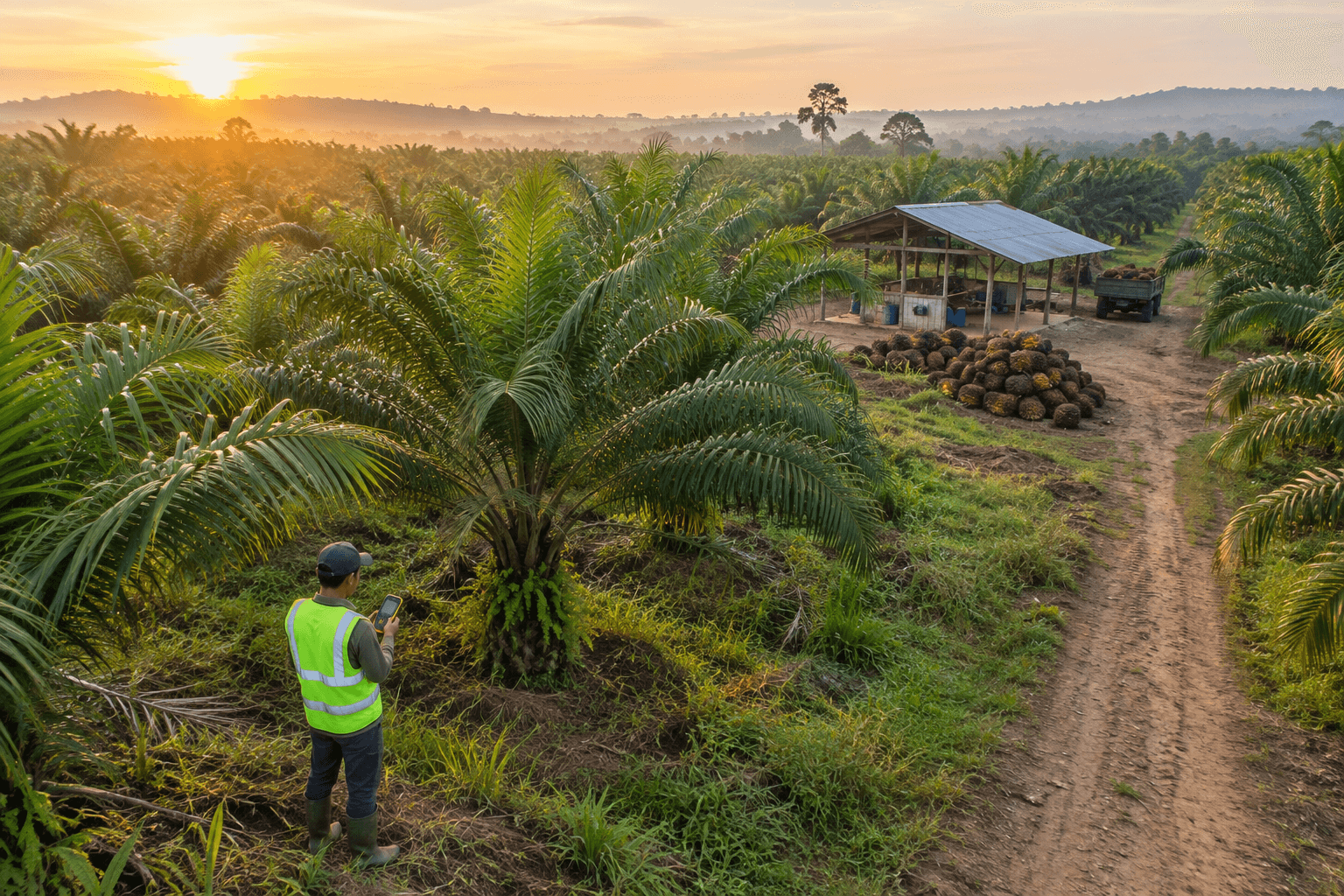
Indonesia and the EU finalised negotiations on the Indonesia-EU Comprehensive Economic Partnership Agreement (IEU-CEPA) in September 2025. The agreement now awaits signature and European Parliament consent. According to the European Commission, the two sides will eliminate tariffs on over 98 percent of tariff lines, with 80 percent liberalised at entry into force. Palm oil, textiles and footwear are among the main sectors for Indonesia.
The EU Deforestation Regulation (EUDR) applies from 30 December. It requires large and medium-sized companies selling palm oil, rubber, coffee, cocoa, wood, soy or cattle products in the EU to trace each shipment to the plot where it was grown. They must also show that the land was not deforested after 2020 and was farmed legally. After two delays, the European Commission said in May that it did not consider further changes to the law appropriate. The rule applies to all countries, including those with free trade agreements.
Registration lags behind the land
Smallholders tend 43.9 percent of Indonesia's oil palm area, according to Statistics Indonesia (BPS), and most of this land is yet to be registered. They tend around 7.09 million ha of oil palm. The Cultivation Registration Certificate (STDB) records a smallholder's identity and plot coordinates, the data EU buyers need to show where a crop came from. As of 3 November, the national crop registration system showed 231,247 STDB and around 839,000 hectares registered or in process, against 12.6 million ha that smallholders tend across coffee, cocoa, rubber and oil palm.
BPS data show Indonesia exported around US$6.9 billion of EUDR products to Europe in 2025, up 23 percent from 2024. Palm oil accounted for $3.9 billion, more than half of the total. Indonesia supplies 23.5 percent of EU imports of palm oil and its derivatives, and more than 40 percent of EU refined palm oil imports. Palm oil exports rose in the first eight months of 2026, while coffee and cocoa exports to the EU fell in value.
The EU removes Indonesia from its Generalized Scheme of Preferences on 1 January. Refined palm oil will then pay a standard tariff of 9 percent. Indonesia is classed as "standard risk", so authorities will check at least 3 percent of operators sourcing from the country each year. Importers file due diligence statements and face maximum fines of at least 4 percent of their EU turnover.
Tariff relief does not settle the compliance question
The two instruments pull in different directions. Lower tariffs under the IEU-CEPA help only goods that can meet the EUDR, so the trade deal does not remove the traceability test. For buyers of palm derivatives, the practical decision is sourcing: which supply chains can document plot origin before 30 December, and which cannot.
The registration gap suggests that documented volumes may be uneven across suppliers. With around 839,000 hectares registered or in process against 12.6 million ha across four crops, many smallholder plots may not yet be traceable. Palm oil carries the largest value at stake, which makes independent oil palm smallholders a likely focus. The existence of a national standard, ISPO, does not by itself answer the plot-level question, and buyers may want to see what coordinate data sits behind a supplier's claim.
Switching costs and the tariff shift
Palm oil exposure is large, but the tariff picture adds a second variable. The 9 percent standard tariff on refined palm oil after 1 January, set against the IEU-CEPA's tariff elimination once it enters into force, could favour processing in Indonesia over shipping raw materials. That may matter to oleochemical buyers weighing where feedstock is converted. Timing is uncertain because the agreement still awaits signature and Parliament consent.
Mapping whole villages through cooperatives and farmer groups could be faster and cheaper than processing individual applications. It will be worth watching whether the share of EU-bound exports traceable to a mapped plot is disclosed by commodity, since that figure would indicate how much of the agreement exporters can use. For formulators and procurement teams, supplier-level evidence of registered plots is likely to count for more than national averages once the regulation applies.